You cannot put a mineral reserve into a motor. A motor maker needs a magnet with the right performance, dimensions, and reliability; a mine produces ore or concentrate. Chemical processing, metal production, alloying, and magnet manufacturing have to connect the two. More ore helps only if the rest of that chain can turn it into a product the maker will accept.
That gap between a deposit and a usable part is why rare earths belong in Pantheon Research. Permanent magnets connect mineral supply to industrial motors, electric vehicles, wind generators, and precision motion. Our robotics piece followed compute and power into physical machines. Here, I follow the magnetic materials that some of those machines also need.
The focus here is Nd/Pr for the core magnet material and Dy/Tb for demanding magnet performance. They are not one supply problem. To judge a deposit, I would ask what it contains and which downstream operations can turn those elements into a magnet a customer can use.
Research cutoff: September 13, 2026. Historical statistics retain their observation year. Project figures are attributed to their owners; targets remain targets.
Which rare earths matter most?
Rare earths comprise 17 elements: the 15 lanthanides, plus scandium and yttrium. They have distinct uses, so there is no defensible universal ranking from most important to least important. A ranking for motor magnets answers a different question from one for lasers, ceramics, or specialty alloys. DOE's rare-earth overview
For the permanent-magnet supply chain, I would organize the priorities this way:
- Dysprosium (Dy) and terbium (Tb): performance-sensitive inputs. These heavy rare earths can increase resistance to demagnetization at elevated temperatures in sintered neodymium-iron-boron magnets. Their strategic relevance depends on the magnet grade and application; their small mass contribution can still determine whether a design meets its operating requirements.
- Neodymium (Nd) and praseodymium (Pr): the core material supply. These light rare earths are the principal rare-earth constituents of NdFeB magnets. Commercial supply often combines them as NdPr rather than separating them into two products.
- Samarium (Sm): a separate magnet system. Samarium-cobalt magnets are particularly useful in high-temperature applications. Securing NdPr does not by itself secure that supply chain. DOE's permanent-magnet assessment, section 2.1
Yttrium also warrants attention beyond magnets. Its uses include ceramics, phosphors, and laser crystals. USGS's 2026 summary estimates 100% U.S. net import reliance for yttrium materials in 2025; that measure excludes yttrium embedded in finished products. USGS: Yttrium, 2026
This is a way to think about industrial supply security, not an official government purchase order. It also keeps lanthanum and cerium from being counted as substitutes for magnet elements simply because the same ore contains them.
China’s advantage grows downstream
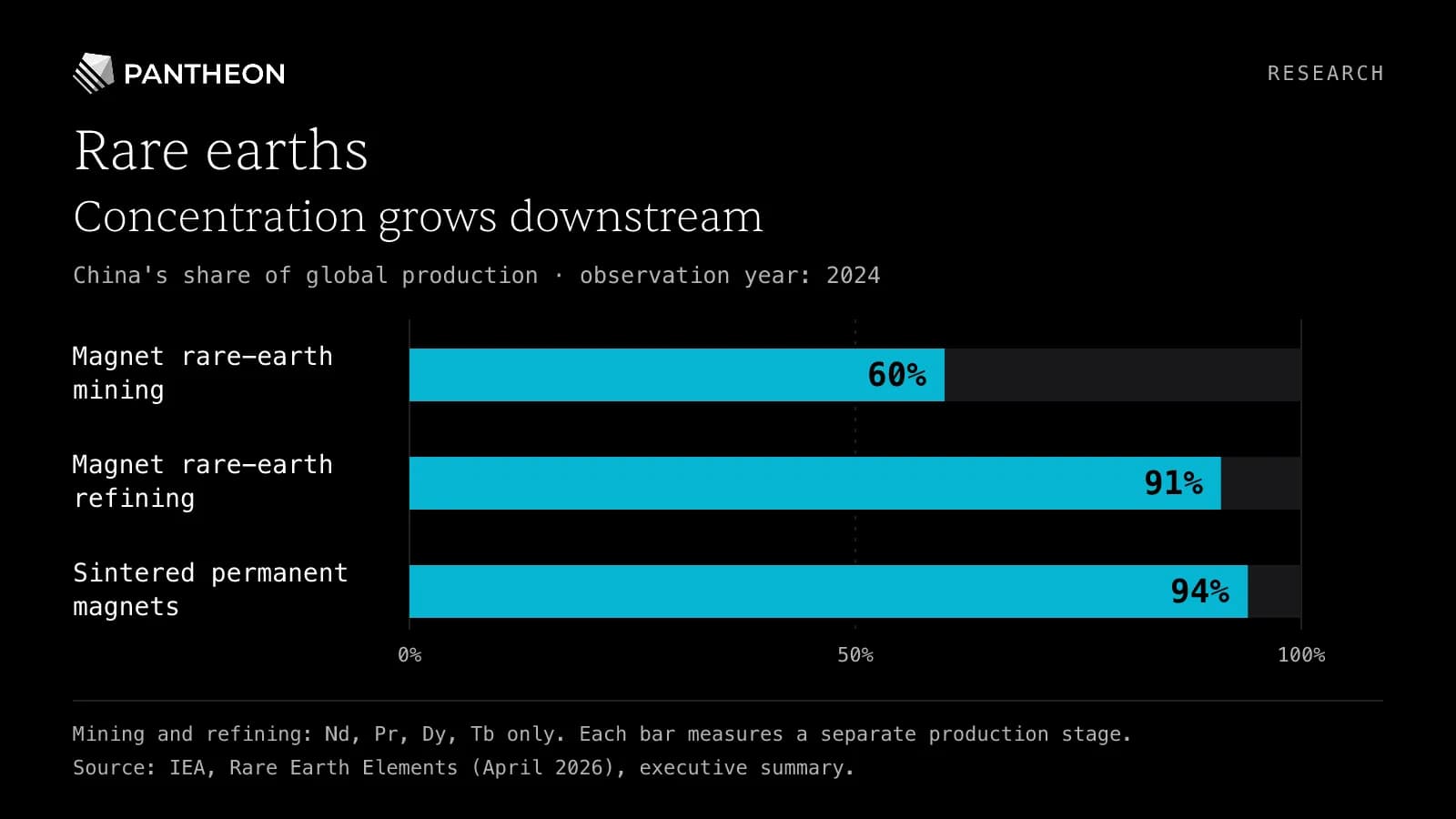
IEA's April 2026 rare-earth report estimates that China supplied 60% of mined magnet rare earths, 91% of refined output, and 94% of sintered permanent magnets in 2024. The mining and refining figures cover Nd, Pr, Dy, and Tb, rather than the entire rare-earth family. Demand for those four elements doubled between 2015 and the report's assessment. IEA: Rare Earth Elements, executive summary
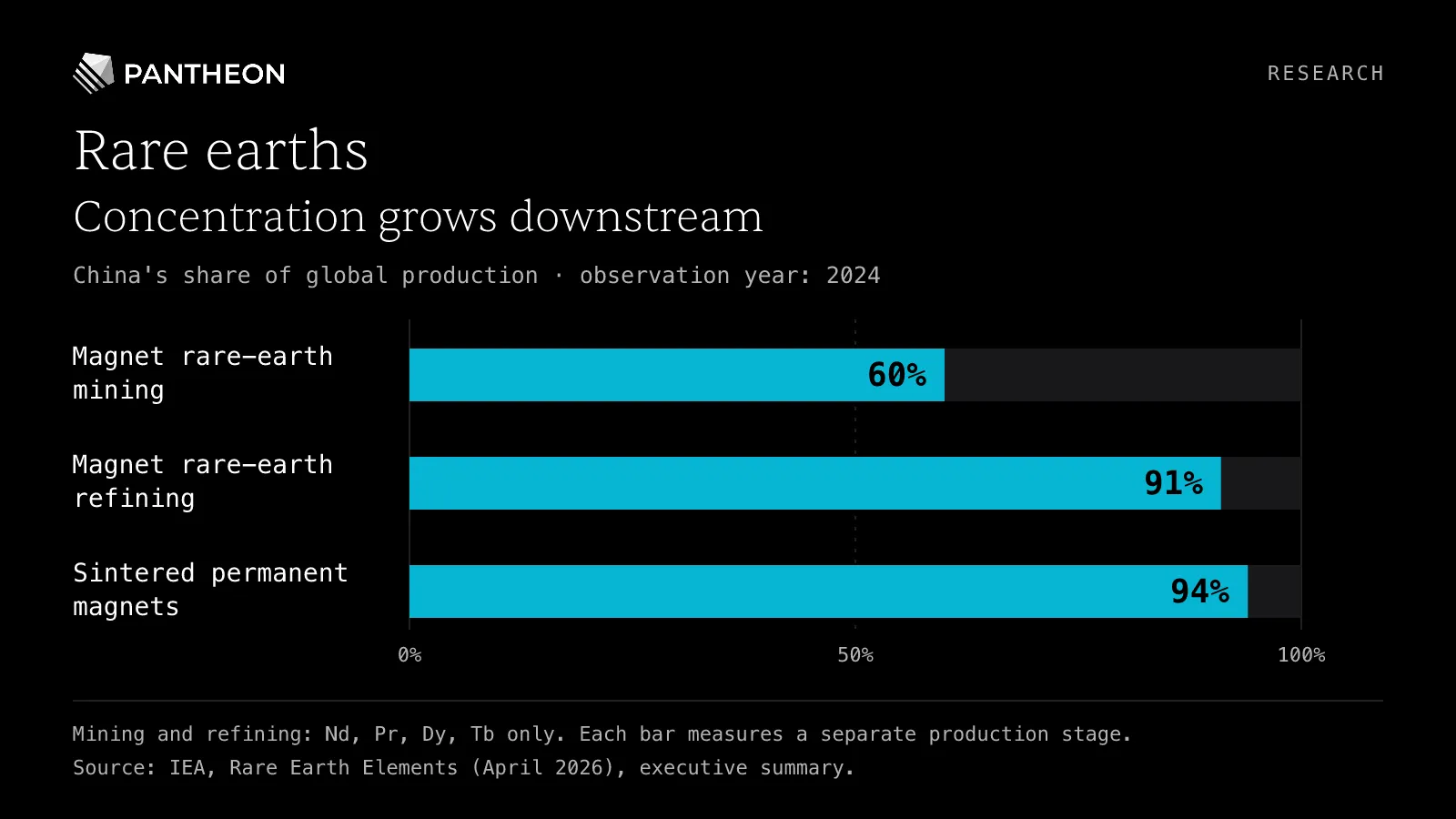
The figures measure different stages of production, not percentages of material retained through one processing circuit. Source: IEA, April 2026 report; underlying observation year: 2024.
There has been progress since that observation year. IEA's August 2026 outlook reports a modest decline in rare-earth refining concentration during 2025, driven by new U.S. projects and increased Malaysian production. It nevertheless identifies an uneven future pipeline: geographically diversified refining capacity amounts to roughly two-thirds of expected mined supply by 2035, while planned magnet production amounts to about one-third. Those are project-based projections, not guaranteed output. IEA: Global Critical Minerals Outlook 2026
A mine outside China can still send its material to China for separation or magnet manufacturing. If the question is whether supply has diversified, the mine's address is only the first address to check.
What nature has to do to concentrate these elements
Nd/Pr: unusual magmas and mineral concentration
Carbonatites are carbonate-rich igneous rocks associated with unusual mantle-derived magmas. Their magmatic evolution and subsequent fluid activity can concentrate rare earths in minerals such as bastnäsite and monazite. These deposits generally favor light rare earths, including Nd and Pr. Mountain Pass is a well-known carbonatite-hosted example.
Peralkaline intrusion-related deposits offer another geological setting. Their mineral assemblages can be richer in heavy rare earths, but the minerals and required processing can differ substantially. A geological label helps narrow an exploration search; it does not establish recoverability. USGS: Carbonatite and peralkaline intrusion deposit model, 2014
Dy/Tb: weathering can change the resource
In ion-adsorption deposits, weathering breaks down rare-earth-bearing minerals. Some released rare-earth ions attach to mineral surfaces in the weathered material. The resulting resource depends on the parent rock, mineral solubility, alteration, and the chemistry of the weathering profile.
The key distinction is total rare-earth content versus the fraction accessible through ion exchange. Research on South Carolina's Liberty Hill granite found large differences between sampled profiles: ion-adsorbed rare earths plus yttrium represented up to 77% of the total in one profile, but only 3–37% in others. Weathered granite is therefore a starting point for investigation, rather than proof of an economically extractable ionic-clay deposit. Bern, Yesavage, and Foley: Liberty Hill study
Ion-adsorption clays are important heavy-rare-earth sources, but Dy and Tb also occur in hard-rock deposits. Browns Range's xenotime-dominant ore, discussed below, illustrates why a search for heavy rare earths should include more than one geological route.
Read the units before ranking the deposits
Three quantities often get blurred:
- Mineral resource: estimated mineralized material, classified by geological confidence and subject to prospects for eventual economic extraction.
- Ore reserve: the economically mineable portion established after applying relevant technical and economic factors.
- Production: material actually produced during a defined period. Nameplate capacity and future run-rate targets are different measures.
The first two terms have formal definitions under reporting codes such as JORC. A resource should not be relabeled a reserve, and country-level estimates should not be assumed to share identical reporting standards. JORC Code, 2012, clauses 20 and 29
TREO means total rare-earth oxides. It reports the oxide-equivalent content of a basket of elements, not tonnes of NdPr, Dy, or Tb alone. Ore tonnage multiplied by TREO grade estimates contained total oxides before recovery losses. An individual element's share and recovery must still be established.
The updated standalone USGS 2026 country table lists reserves of 44 million tonnes REO for China, 11 million for Brazil, 6.3 million for Australia, and 1.9 million for the United States. Brazil's figure differs from the 21 million tonnes in the 2025 edition. This is a revision to a reported estimate; it should not be interpreted as that much material having been mined or disappearing. Neither table establishes country-level recoverable Dy/Tb inventories. USGS: Rare Earths, updated 2026 chapter, 2025 summary
Five projects that illustrate the supply problem
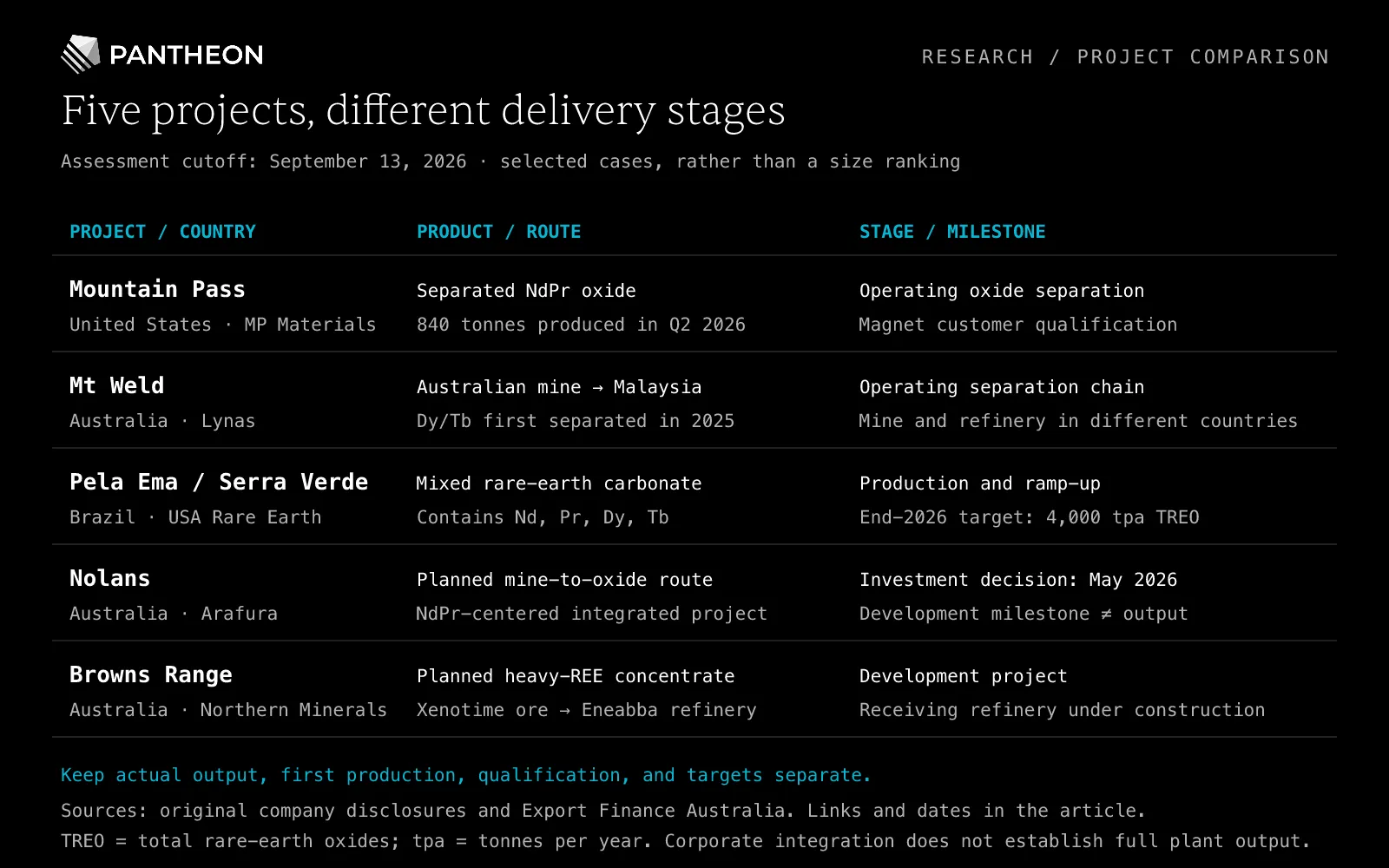
These cases were selected to compare geological and processing routes. They are not a ranking of the world's largest deposits. Their reported resources, reserves, output, and targets have different denominators and should be read accordingly.
1. Mountain Pass — California, United States; MP Materials
Route: bastnäsite ore, concentration, and domestic NdPr separation, with downstream metal and magnet operations in Texas.
MP reported 840 metric tonnes of finished NdPr oxide production in the second quarter of 2026. Its August 6 release also describes deliveries of magnets from the Independence facility for customer qualification and regulatory testing. Actual oxide output and qualification-stage magnets are distinct milestones; they should not be combined into a claim that all downstream capacity is already operating at scale. MP Materials: Q2 2026 results
What this case shows: domestic mining can be connected to domestic processing, but customer acceptance remains a separate step after building the manufacturing line.
2. Mt Weld — Western Australia; Lynas Rare Earths
Route: mine and concentration in Australia, linked to processing in Australia and separation in Malaysia.
Lynas's August 2024 estimate reports a 106.6-million-tonne mineral resource at 4.12% TREO, containing 4.39 million tonnes of total oxides. This is a mineral resource, not an estimate of recoverable magnet elements alone. Lynas: Mt Weld resource update
In June 2025, Lynas announced first separated terbium oxide production in Malaysia, following first dysprosium oxide production in May. Both used Mt Weld feedstock. This establishes a non-Chinese separation route and makes an undated claim of “100% Chinese Dy/Tb processing” inappropriate. First production, however, does not establish the size of a sustained supply contribution. Lynas: first terbium production, June 18, 2025
What this case shows: supply diversification can involve a traceable chain across countries, with the mine's geology supporting more than its principal light-rare-earth product.
3. Pela Ema / Serra Verde — Goiás, Brazil; USA Rare Earth
Route: ionic-clay mining and processing into mixed rare-earth carbonate containing Nd, Pr, Dy, and Tb. A mixed carbonate remains an intermediate requiring separation. USA Rare Earth: operations
USA Rare Earth completed its Serra Verde combination on September 3, 2026. Its September 4 announcement says production began in January 2024 and optimization and commissioning were ongoing. It targets an approximately 4,000-tonne-per-year TREO run-rate by the end of 2026, with an expansion targeting 6,400 tonnes annually. These are company targets for total oxide content, rather than actual annual output or tonnes of separated Dy/Tb. USA Rare Earth: completion announcement
What this case shows: an operating heavy-rare-earth-bearing mine can improve feedstock diversity while still depending on successful ramp-up and downstream integration.
4. Nolans — Northern Territory, Australia; Arafura Rare Earths
Route: an integrated mine-to-separated-oxide project centered on NdPr.
Arafura's published reserve table, dated March 16, 2020, reports 29.5 million tonnes of ore at 2.9% TREO, with NdPr oxides representing 26.4% of the total rare-earth-oxide basket. That enrichment figure is not 26.4% of the ore's mass. Arafura: Nolans resources and reserves
The Australian government's May 21, 2026 release confirms a final investment decision. It also describes a non-binding commitment to secure material through Australia's strategic reserve. An investment decision advances development; a non-binding commitment is not a completed purchase. Neither establishes commercial production. Export Finance Australia: Nolans investment decision
What this case shows: reserve quality, financing, construction, and finished-product supply are sequential tests of an integrated project's delivery.
5. Browns Range — Western Australia; Northern Minerals
Route: xenotime-dominant hard-rock ore targeting a mixed heavy-rare-earth concentrate for Iluka's Eneabba refinery.
Northern Minerals describes a planned mining and beneficiation chain supplying Eneabba under its Iluka partnership. This is a development route for Dy/Tb-bearing feedstock, rather than an existing supply of separated oxides from a fully operating chain. Northern Minerals: Browns Range project
Iluka's refinery is under construction, with commissioning scheduled for 2027. That date remains a schedule, not evidence that qualifying output is available today. Iluka: Eneabba construction and commissioning
What this case shows: the mine and receiving refinery have interdependent schedules. Assessing either asset in isolation misses the delivery constraint.
What stockpiling can accomplish
On February 2, 2026, EXIM approved a direct loan of up to $10 billion for Project Vault, the U.S. Strategic Critical Minerals Reserve. The program covers critical raw materials more broadly than rare earths and involves manufacturers and private capital providers. The announcement establishes financing approval, rather than proof that the entire amount has been disbursed or used to acquire minerals. EXIM: Project Vault approval
A stockpile can bridge a disruption only if its contents match the missing production stage. A manufacturer short of qualified magnets cannot immediately substitute stored mixed concentrate. The practical question is therefore what form is held, which facilities can process it, and how quickly it can reach a customer.
Stockpiling and building processing capacity serve different time horizons: inventory provides a buffer, while new facilities create a replenishment route. Their usefulness should be evaluated together.
Substitution changes the demand side
Dy and Tb are not mandatory ingredients in every NdFeB magnet. In 2018, Toyota announced a heat-resistant magnet design eliminating both and reducing neodymium use by substituting some lanthanum and cerium. That is evidence of a technical route, rather than proof that every motor design can use the same substitution or that it has replaced conventional magnets across the market. Toyota: neodymium-reduced magnet development
Supply forecasts consequently need to consider magnet composition as well as the number of motors produced. A design that meets customer requirements with less heavy rare earth can reduce exposure without adding a mine. The relevant comparison includes performance, manufacturing readiness, and any redesign needed in the end product.
Environmental performance is part of the processing test
Processing conditions vary by deposit. Leaching requires water and chemical management; extraction and refining generate residues that must be handled over the project's life. Some rare-earth ores contain thorium or uranium, which can become concentrated in process residues. “Ionic clay” or “hard rock” alone establishes neither an environmental outcome nor a permitting advantage. USGS: Rare-earth deposit model, environmental considerations
For a particular project, the useful evidence includes the proposed extraction method, reagent consumption, water balance, residue characterization, rehabilitation plan, and engagement with affected communities. A comparison should use the actual flowsheet and local conditions, rather than a generic claim that one deposit class is clean or cheap.
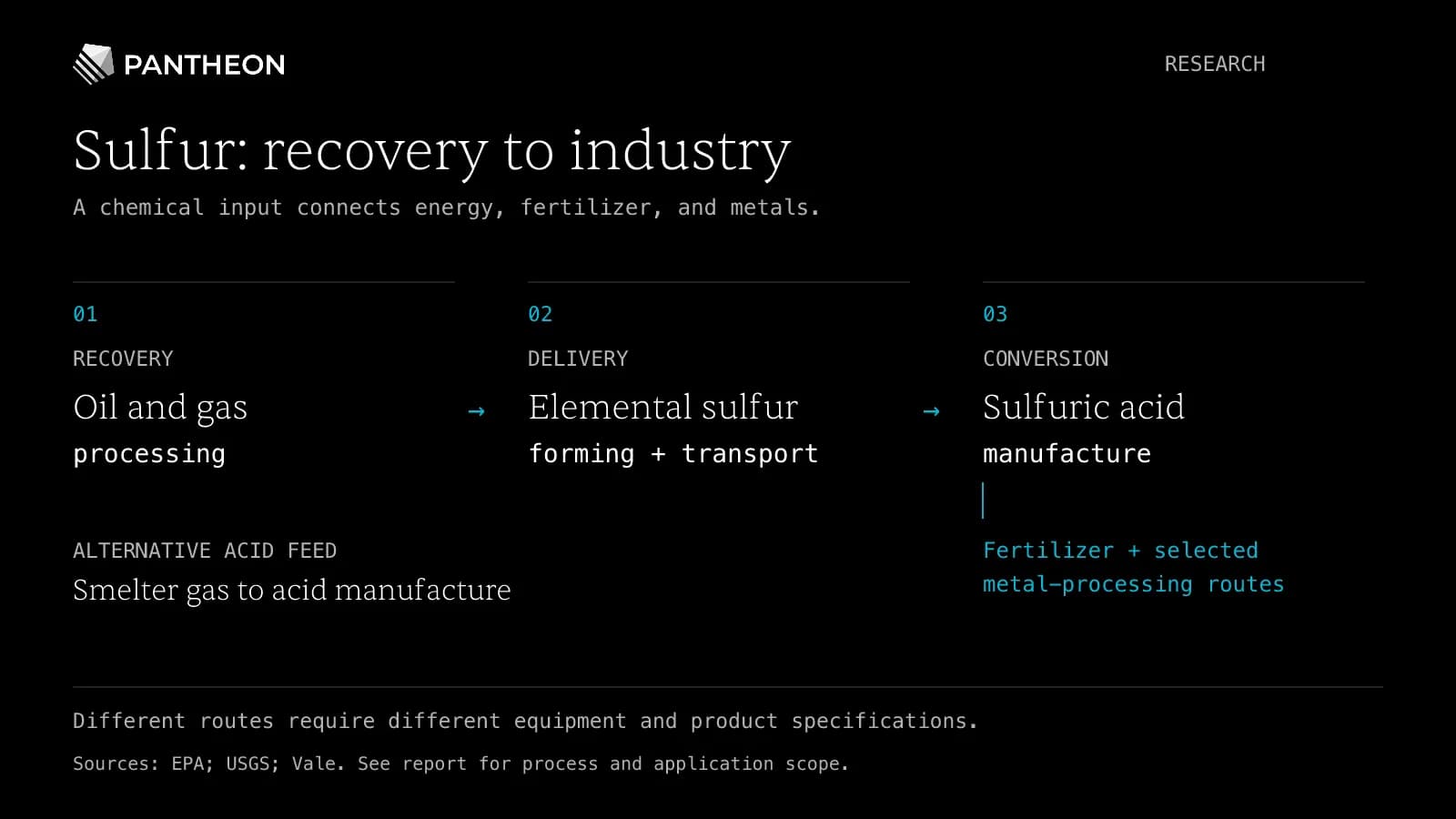
Reagent availability also belongs in that assessment. IEA's 2026 critical minerals outlook identifies sulfur supply disruptions as a risk to rare-earth production and other processing chains. Our sister report on sulfur recovery, sourcing, and industrial demand follows that input through recovery, transport, and acid manufacture. The dependency should be checked against each project's actual flowsheet. IEA: Global Critical Minerals Outlook 2026, market overview
The measures I would track
When I look at a new supply project, these are the five questions I would keep in front of me:
- Element-specific recovery: how much NdPr, Dy, and Tb a representative feed yields, rather than TREO grade alone.
- Product specification: whether the result is concentrate, mixed carbonate, separated oxide, metal, alloy, or magnet.
- Processing locations: where each conversion takes place and which external suppliers it depends on.
- Actual output and customer acceptance: sustained production, consistency, and qualification milestones alongside stated capacity.
- A funded path through the chain: construction progress, counterparties, and the status of supply agreements, including any conditions.
These questions are assessment criteria, not a project score or a forecast of financial returns. The material becomes useful to this infrastructure story when it reaches a motor, actuator, or generator in a form the customer accepts. The neighboring constraints are in our pieces on robotics infrastructure and time to energized.
Sources and method
This report uses government statistics, IEA analysis, a geological research paper, and original company disclosures linked beside the claims they support. The 2022 DOE report supports magnet chemistry and process descriptions; its historical market-share estimates are not used as current statistics. Company resource estimates and production targets are attributed rather than independently certified by Pantheon. Selection of the five cases and the assessment criteria are our synthesis.
USGS's 2026 rare-earth chapter is the basis for the country reserves quoted here. The agency's revision history explicitly records Brazil's change from 21 million to 11 million tonnes in version 1.3, reposted May 27, 2026. Older archived downloads can retain the earlier figure. Reserves, resources, oxide content, actual production, and future capacity are kept separate throughout. Ownership and project milestones were checked against disclosures available by the research cutoff; subsequent events can change the comparison.
Pantheon Research examines the physical infrastructure behind AI and industry: power, compute, equipment, and the supply chains that determine what can be delivered.
Milo
Expert in manufacturing technology and industrial solutions, sharing insights on the latest trends and best practices.