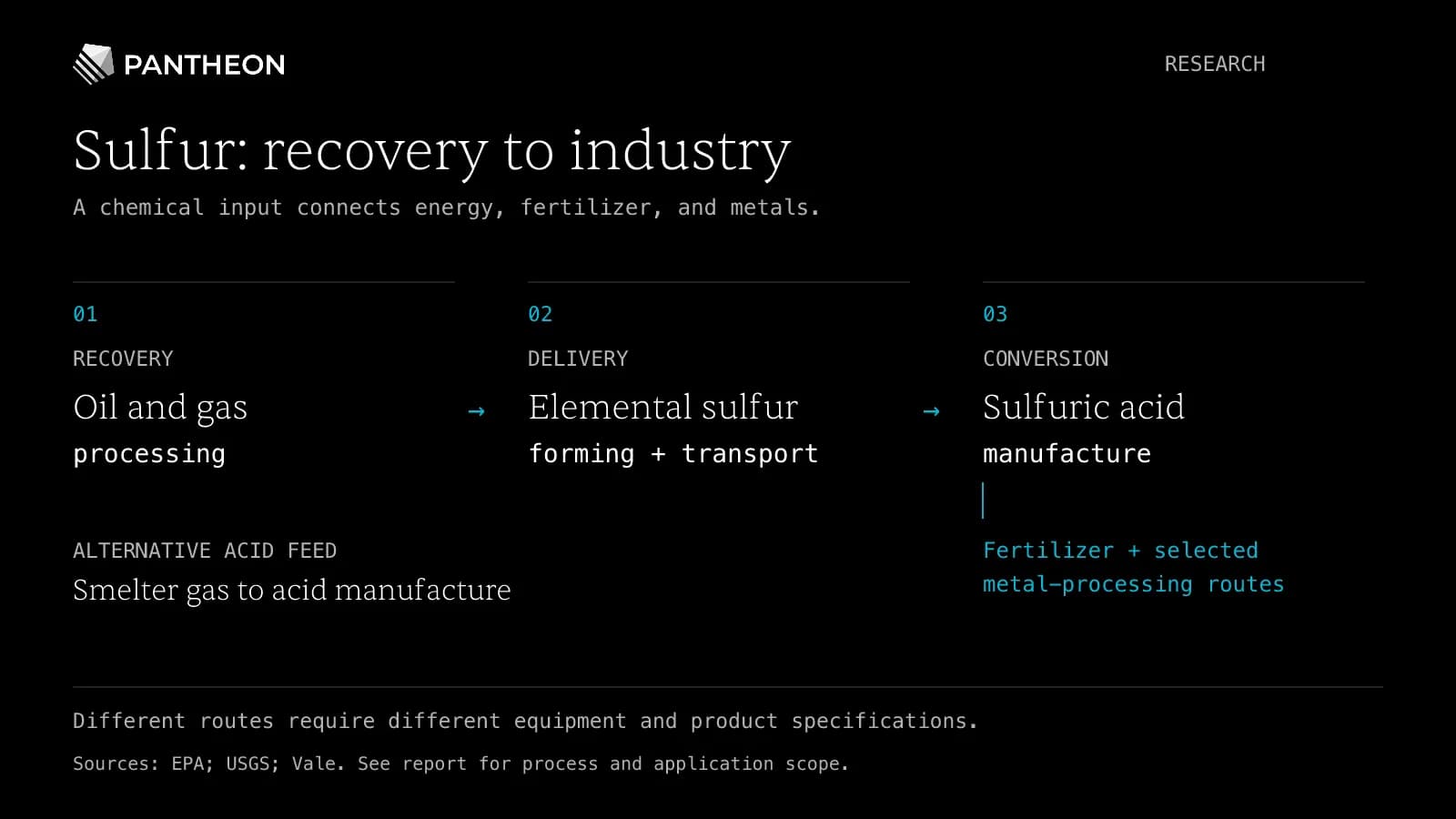
A supplier can have recovered sulfur ready to sell while a plant is still short of the sulfuric acid it needs. A fertilizer producer uses acid to process phosphate rock; a nickel operation using acid leaching needs a dependable reagent supply. For a recovered-sulfur route, the material still has to be formed, transported, converted, and delivered in a form the customer can actually use. A production total skips most of that journey.
In our rare-earth report, the question was how a deposit becomes a motor magnet. Here it is how a process chemical reaches the plant that needs it. Sulfur may be absent from the finished machine, yet a shortage of the right chemical can still hold up the metal that machine requires.
This report focuses on elemental sulfur, sulfuric acid, and the infrastructure between them and industrial buyers. Production is not the same as exportable surplus. An available cargo is not useful to a plant that cannot receive or process it.
Research cutoff: September 13, 2026. Country production figures are USGS estimates for 2025. Company capacities and historical operating milestones retain their source dates; capacity is not actual output. The country selection and sourcing criteria are our synthesis.
Which forms of sulfur matter most?
Sulfur is an element, but industrial buyers encounter several products. I would organize the supply question this way:
- Elemental sulfur: recovered material sold in solid forms such as granules or prills, or as molten sulfur. The form determines which loading, storage, and receiving equipment is needed.
- Sulfuric acid: a chemical product made from sulfur-bearing inputs. Concentration, impurities, transport equipment, and the customer's process requirements matter alongside tonnage.
- Sulfur contained in other products: sulfates, sulfide minerals, and sulfur-bearing feedstocks. Their sulfur content does not make them immediately interchangeable with an elemental sulfur cargo.
The Sulphur Institute describes recovered sulfur and sulfuric acid as central industrial products, with applications across fertilizers, chemicals, and manufacturing. The Sulphur Institute: sulfur FAQ
That difference changes what a buyer can source. A plant with a sulfur-burning acid unit can consider elemental sulfur. A plant set up to receive merchant acid needs acid deliveries, unless it adds a conversion route. A country production total tells you neither which product is available nor whether the plant can use it.
Why demand is large—and where it is changing
Fertilizer provides the largest demand anchor. The Sulphur Institute's fact sheet estimates that roughly 60% of sulfur produced goes to fertilizer. That is an industry-association estimate, rather than a country-by-country consumption balance or a measured annual growth rate. The Sulphur Institute: fact sheet
One major reason is chemistry. In the wet process, sulfuric acid reacts with phosphate rock to produce phosphoric acid, while calcium sulfate is separated as gypsum. EPA's 2022 supply-chain profile notes that many phosphoric acid producers manufacture sulfuric acid on site from sulfur. The dependency exists even when the fertilizer's purpose is to deliver phosphorus. Sulfur also has a separate role as a plant nutrient. EPA: Phosphoric Acid supply-chain profile, December 2022, The Sulphur Institute: sulfur FAQ
Metal processing adds demand where the chosen extraction route consumes acid. At Indonesia's Pomalaa HPAL project, Vale's December 2025 construction update describes sulfuric acid reacting with laterite ore slurry under elevated temperature and pressure to dissolve nickel and cobalt. The resulting mixed hydroxide precipitate is an intermediate for battery materials. Arrival of equipment at a project establishes construction progress; it does not establish sustained production or its current acid consumption. Vale: Pomalaa HPAL milestone, December 13, 2025
Chile illustrates another demand center. COCHILCO's 2024–2033 sulfuric acid market assessment links acid requirements to copper hydrometallurgy and projects a continuing national supply deficit. It also anticipates declining demand later in the period as some oxide operations end. Demand therefore depends on the processing mix and mine schedule, alongside the amount of metal the world wants. COCHILCO: Chilean sulfuric acid market, 2024–2033
Fertilizer, metals, and other industries create substantial demand, but they do not make every sulfur market short. Nor do they grow at the same rate everywhere. For a particular plant, the useful comparison is its own consumption against supply that can reach it in the form it needs.
What sulfur has to do with heavy hardware and turbines
Sulfuric acid can support material preparation. EPA's steel-industry development document describes acid pickling as a way to remove surface oxides before subsequent processing. The acid varies: carbon-steel pickling commonly uses hydrochloric acid, while stainless-steel operations can use combinations that include sulfuric acid. Sulfuric acid is consequently relevant to some manufacturing routes, rather than a universal reagent for every steel part. EPA: Iron and Steel development document, 2002
Gas turbines also use demanding nickel alloys. Special Metals identifies turbine applications for alloys including INCONEL 706 and 718. That establishes the importance of qualified alloy supply; it does not mean the nickel intermediate from a battery-focused HPAL project can be delivered directly to a turbine manufacturer. Refining, alloy composition, cleanliness, and customer qualification remain separate steps. Special Metals: alloy quick-reference guide
For finished hot-section materials, residual sulfur can be harmful. NASA research on nickel-base turbine blades describes desulfurization to improve the stability of their protective oxide. Related research explains that sulfur segregation at the metal–oxide interface can weaken adhesion and contribute to oxide loss. These are historical materials studies, rather than a claim about every modern blade specification. NASA: Desulfurization of Gas-Turbine Blades, 1994, NASA: materials research highlights
The distinction is useful: sulfur can enable upstream chemical processing while its residue must be controlled in a finished alloy. Turbine manufacturing is a reason to trace the metal supply chain carefully. The evidence here does not identify it as the principal driver of global sulfur demand.
What production has to do to create usable supply
Oil and gas: recovering a removed impurity
Sulfur recovery turns a separated contaminant into a product. Processing sour natural gas and sulfur-bearing petroleum can produce hydrogen sulfide streams. The Claus process converts that hydrogen sulfide into elemental sulfur. Recovery is integrated with the operation treating the original feedstock. EPA: AP-42, Sulfur Recovery
This creates a different supply problem from opening a dedicated mine. A buyer assessing additional sulfur should ask about feedstock throughput, sulfur content, recovery performance, forming capacity, and transport. An attractive sulfur price alone does not establish that the host energy operation can increase throughput.
Smelting: a separate route to acid
USGS's sulfur accounting also includes sulfur recovered as byproduct sulfuric acid, notably from metallurgical processing. Some countries' totals include acid made from pyrite. These routes contribute sulfur content to production statistics without necessarily producing elemental sulfur for export. USGS: Sulfur, Mineral Commodity Summaries 2026
That makes the receiving plant part of the supply assessment. Merchant acid from a suitable source can serve an acid consumer directly. It cannot be treated as a ready replacement cargo for equipment designed to receive and burn solid sulfur.
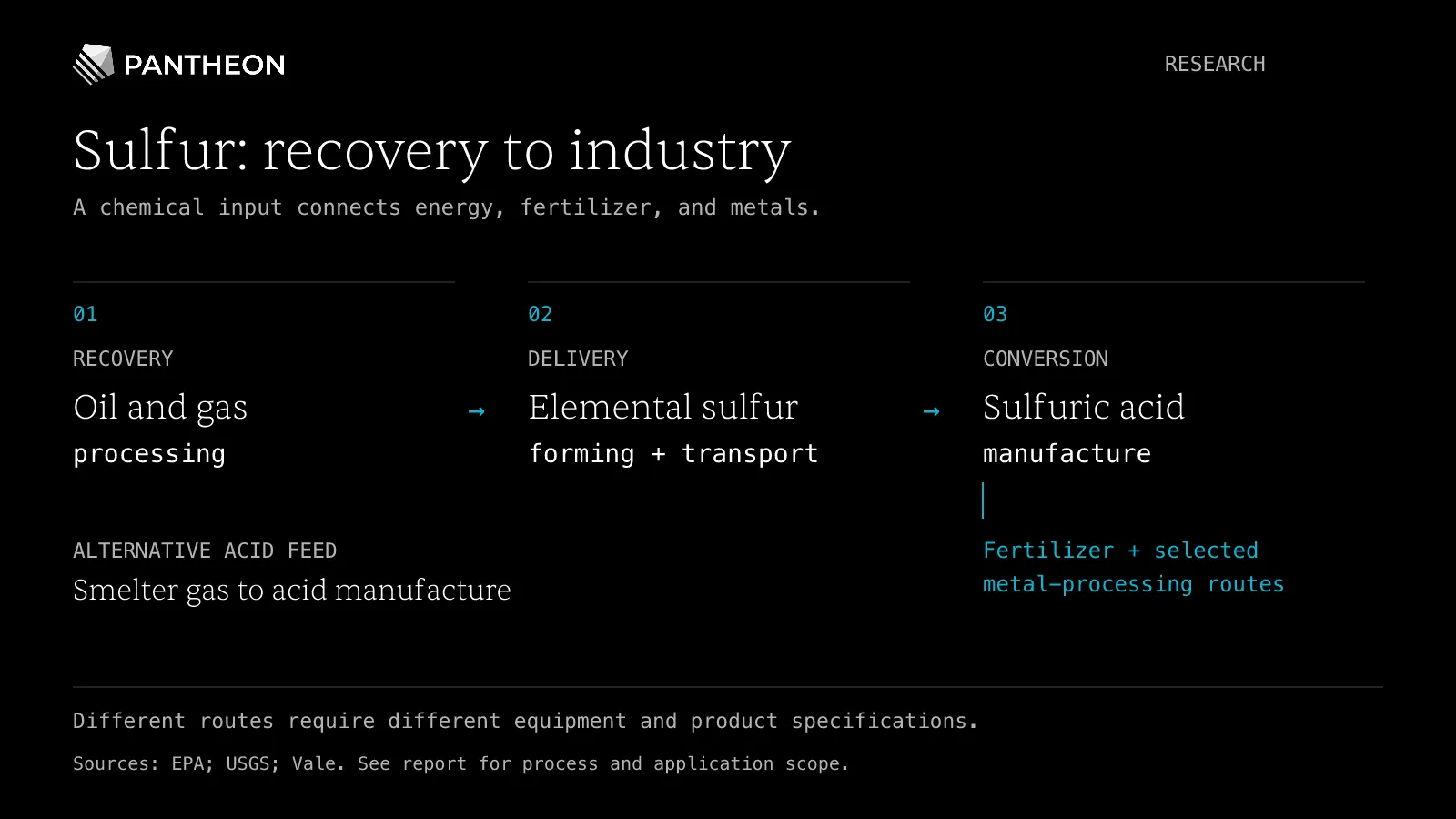
The diagram shows alternative production routes, rather than a universal flowsheet. Acid demand and purity requirements vary by application. Sources: EPA sulfur recovery and phosphoric acid profiles; USGS sulfur summary; Vale's Pomalaa process description.
Read the units before ranking the countries
USGS estimates 84 million metric tonnes of world sulfur production in 2025. Its table measures sulfur content across all reported forms, including byproduct acid. Selected producers are shown below. These are production estimates, not elemental sulfur export rankings. USGS: Sulfur, 2026
- China: 19.0 million tonnes.
- United States: 8.1 million tonnes.
- Russia: 7.5 million tonnes.
- Saudi Arabia: 7.2 million tonnes.
- United Arab Emirates: 6.3 million tonnes.
- Canada: 5.0 million tonnes.
- Kazakhstan: 4.8 million tonnes.
- Qatar: 3.1 million tonnes.
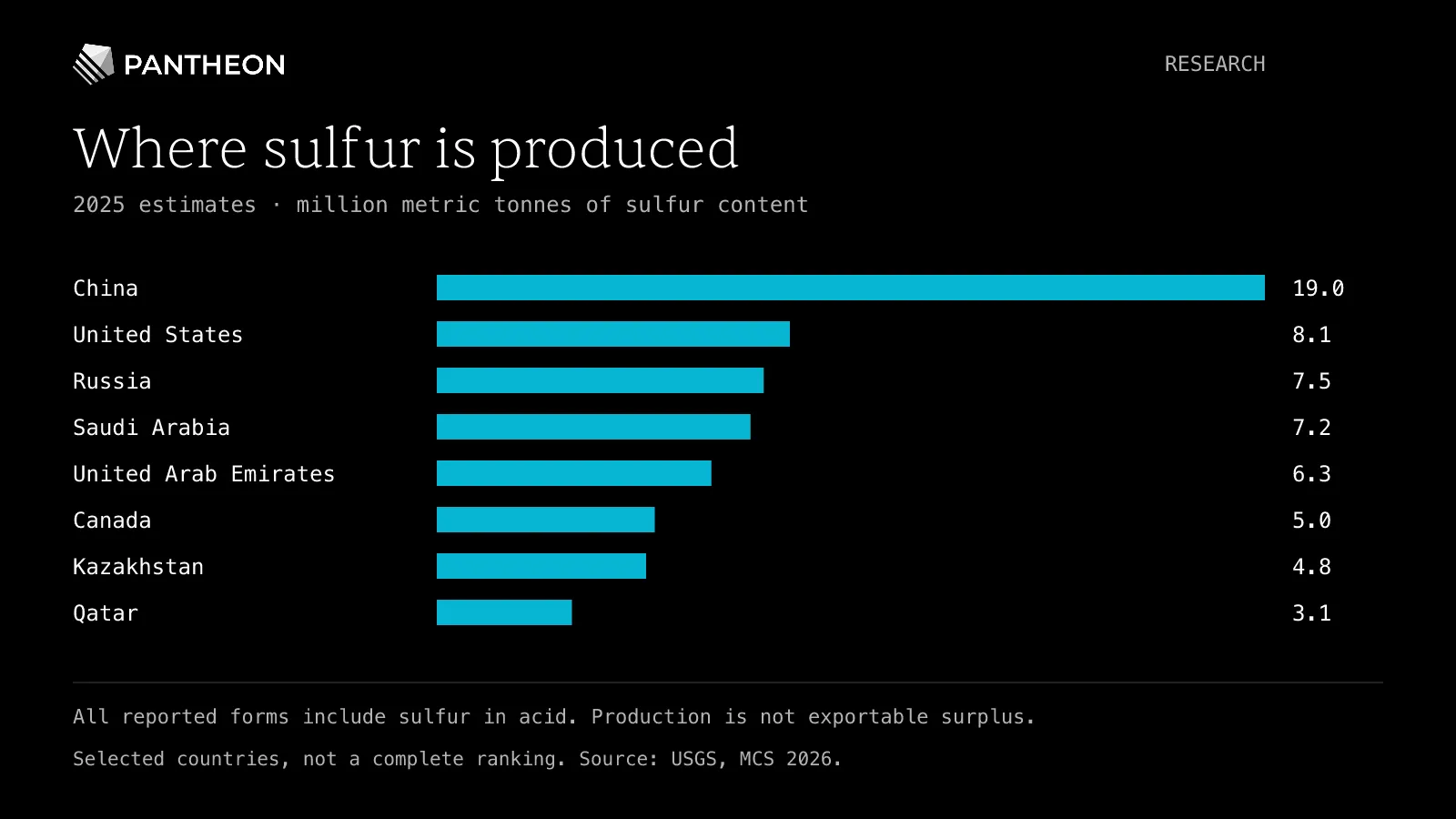
Selected countries, not a complete ranking: India and South Korea are among the omitted producers. Source: USGS, 2026 edition; underlying year: 2025 estimates. The total includes sulfur in acid and is not a measure of exportable elemental sulfur.
Three further distinctions matter. Tonnes of sulfur and tonnes of sulfuric acid describe different masses. Acid concentration changes the amount of active chemical delivered. Capacity and output describe different evidence. A nameplate figure does not prove utilization or spare supply. Production and exports describe different balances. Domestic consumption, inventories, and logistics determine what can leave a country.
China and Russia warrant attention for production scale; the United States matters as both a producer and an industrial buyer. Qatar adds another Gulf source to examine. None of those observations establishes uncommitted cargo availability. A sourcing comparison needs product-specific trade data and supplier evidence in addition to this table.
Five cases that illustrate the supply problem
1. United Arab Emirates: Shah recovery and the export chain
Route: sour gas → recovered sulfur → granulation → rail → Ruwais export terminal.
ADNOC Sour Gas describes Shah's sulfur capacity as 4.2 million tons per year and says its granulated product moves by rail to Ruwais. Its public operating description identifies feed gas containing more than 23% hydrogen sulfide. The company page supplies a capacity figure and a physical route; it does not provide a dated annual sulfur output figure for this comparison. ADNOC Sour Gas: Delivering Resources
What this case shows: recovery, forming, rail, and the terminal are all relevant assets. A large recovery unit cannot establish delivered supply on its own.
2. Saudi Arabia: the loading port matters
Route: sulfur supply → trading and export infrastructure → specified regional loading port → customer.
Aramco Trading describes sulfur exports from both the Arabian Gulf and Red Sea regions. That makes Saudi Arabia strategically interesting beyond its production total. The disclosure establishes regional export activity; it does not establish which facility supplies a particular contract, spare capacity on either coast, or the ability to divert a cargo between them. Aramco Trading: Sulfur
The distinction has practical weight. IEA's 2026 critical minerals outlook estimates that the Middle East supplies roughly one-quarter of global sulfur and that half of global seaborne sulfur trade passes through the Strait of Hormuz. It reports disruption effects on fertilizer and metal-processing inputs. That is the report's assessment, rather than a live shipping-status update for September 13. IEA: Global Critical Minerals Outlook 2026, market overview
What this case shows: name the loading port and actual route. Two country labels can share a chokepoint; two ports in one country can have different exposures.
3. Canada: inland recovery needs a working rail corridor
Route: western Canadian sulfur-forming facilities → rail → Port Moody or North Vancouver → ocean freight.
Sultran describes coordinating export sulfur from nine inland facilities in Alberta and British Columbia using the CN and CPKC rail networks. It identifies Port Moody and North Vancouver as export destinations and describes solid sulfur moving in dedicated railcars. This is the operator's description of its network, not an independently measured annual export total. Sultran: operations and handling
Canada therefore provides a route to evaluate outside the Gulf. Its usefulness to a particular buyer still depends on available inland volumes, rail service, terminal allocation, vessel scheduling, and the destination's receiving equipment.
What this case shows: geographic diversification has an operating cost and a physical delivery chain. A different origin is valuable when the entire route can perform.
4. Kazakhstan: Tengiz makes the constraints explicit
Route: recovered sulfur → liquid, granulated, or crushed product → rail and terminal capacity → end user.
Tengizchevroil produces sulfur alongside crude oil and gas. Its published sales strategy distinguishes liquid sulfur deliveries limited by rail tank-car availability, granulated exports limited by forming or terminal capacity, and crushed block sulfur movements limited by recovery or railway capacity. It also describes a preference for direct end-user sales and review of participants throughout the sales chain. Tengizchevroil: products and sulfur sales strategy
The company's February 2026 announcement reports increased crude output during 2025 following the start of its Third-Generation Plant. That energy milestone should not be converted into an assumed proportional increase in sulfur available to a new customer. Tengizchevroil: 2025 business performance, February 12, 2026
What this case shows: product form, equipment, allocation, and counterparty approval can determine access. National production is only the beginning of the inquiry.
5. Morocco: phosphate capacity depends on acid infrastructure
Route: sulfuric acid manufacture + phosphate rock processing → phosphoric acid → fertilizer.
OCP's financial statements for 2024, published in March 2025, describe the startup of two sulfuric acid lines at Jorf Lasfar and another at Safi, alongside fertilizer capacity expansion. These are dated operating milestones, rather than a complete account of the group's acid balance in 2026. OCP: 2024 financial statements
Morocco belongs in this comparison as a downstream industrial demand center. The country's phosphate resource does not remove the requirement for sulfuric acid in the wet-process chain. To assess additional fertilizer output, examine acid availability and operating capacity alongside phosphate and fertilizer assets.
What this case shows: countries of strategic interest include consumers and conversion centers. The useful map follows the chemical through the plant that needs it.
What stockpiling can accomplish
A sulfur inventory can buffer missed deliveries if the site can store, reclaim, and process the held product. An acid inventory can provide a different buffer if the receiving system is suitable. Their usefulness depends on the same product and equipment distinctions described above.
For a plant-level assessment, measure inventory in days of usable consumption, alongside tonnes. Ask whether a buffer survives a disruption to the acid unit, the port, or the inland route. Stored elemental sulfur cannot keep an acid-dependent process running through an acid-plant outage unless another conversion or acid-delivery route is available.
These are operating assessment criteria, rather than a recommendation for a particular inventory level. The appropriate buffer depends on consumption, replenishment time, and the facility's storage limits.
Substitution changes the demand side
Acid regeneration offers one route to reduce fresh acid requirements in suitable applications. Chemtrade describes regenerating spent sulfuric acid used as a catalyst in refining and chemical operations, producing material for reuse or merchant sale. That is an established service for those streams, rather than proof that acid consumed in phosphate manufacture or ore leaching can be recovered in the same way. Chemtrade: Regenerated Acid
OCP's 2024 sustainability report also describes development of a pilot unit to recover sulfur from phosphogypsum. Its 2025 sustainability site continues to identify sulfur extraction among research pathways. Research and pilot development are evidence of a possible future route, not replacement supply that a buyer can assume is operating today. OCP: Sustainability Report 2024, OCP: 2025 sustainability research pathways
A substitution assessment should follow the actual chemistry. Lower reagent consumption, regeneration, alternative feedstocks, and a different extraction route have different effects on equipment, residues, product quality, and supply exposure.
Environmental performance is part of the processing test
Sulfur recovery manages a hazardous constituent of energy feedstocks, but the full chain still needs emissions control, safe storage, and transport. Sultran's handling description identifies dust suppression, product sampling, moisture analysis, and terminal checks as parts of its logistics work. These are operational controls to examine at a specific supplier, rather than a certification of every sulfur shipment. Sultran: Contract Management
At the consuming plant, environmental requirements follow the process. EPA's phosphoric acid description identifies gypsum separation and acidic water management as parts of wet-process manufacture. Buying recovered sulfur does not by itself establish the environmental performance of the fertilizer or metal made with it. EPA: AP-42, Phosphoric Acid
The useful evidence includes the facility's feedstock, acid balance, water balance, emissions controls, residue handling, and ability to operate within its local requirements.
The measures I would track
For a buyer, I would work through the supply chain in this order:
- Product and specification: elemental sulfur or acid; physical form, acid concentration, impurities, and receiving requirements.
- Actual available volume: sustained output, domestic commitments, inventories, and exportable surplus alongside stated capacity.
- Every delivery stage: recovery, forming or acid manufacture, rail, loading port, shipping route, and inland delivery to the customer.
- Customer acceptance and contract status: approved suppliers, product consistency, allocated volumes, delivery terms, and any conditions.
- A workable disruption buffer: usable inventory, alternative routes, spare conversion capability, and replenishment time.
This is a way to assess a supply route, not a supplier score or a price forecast. The question is whether usable chemical reaches the plant in time for it to make the fertilizer or metal another industry needs. Our sister report follows rare earths into motor magnets; time to energized covers equipment and power constraints further along the chain.
Sources and method
This report uses government statistics and process documents, IEA analysis, historical NASA materials research, an industry-association demand estimate, and original company disclosures linked beside the claims they support. Older technical documents support chemistry and materials mechanisms; their historical market figures are not used as current statistics.
USGS's 2026 sulfur chapter supplies the selected country estimates for 2025. Its all-forms sulfur-content measure is kept separate from elemental sulfur trade, acid tonnage, company capacity, and actual annual output. The selected countries are not a complete producer ranking. No uniform national export balance or current cargo-availability comparison is claimed.
The five cases illustrate different constraints rather than identify the five largest or best suppliers. Company network descriptions and milestones are attributed, not independently certified by Pantheon. The analysis of delivery chains, inventory, and qualification is our synthesis. IEA's disruption assessment is dated report evidence; current shipping conditions and supplier allocations require a fresh check before a sourcing decision.
Pantheon Research examines the physical infrastructure behind AI and industry: power, compute, equipment, and the supply chains that determine what can be delivered.
Milo
Expert in manufacturing technology and industrial solutions, sharing insights on the latest trends and best practices.